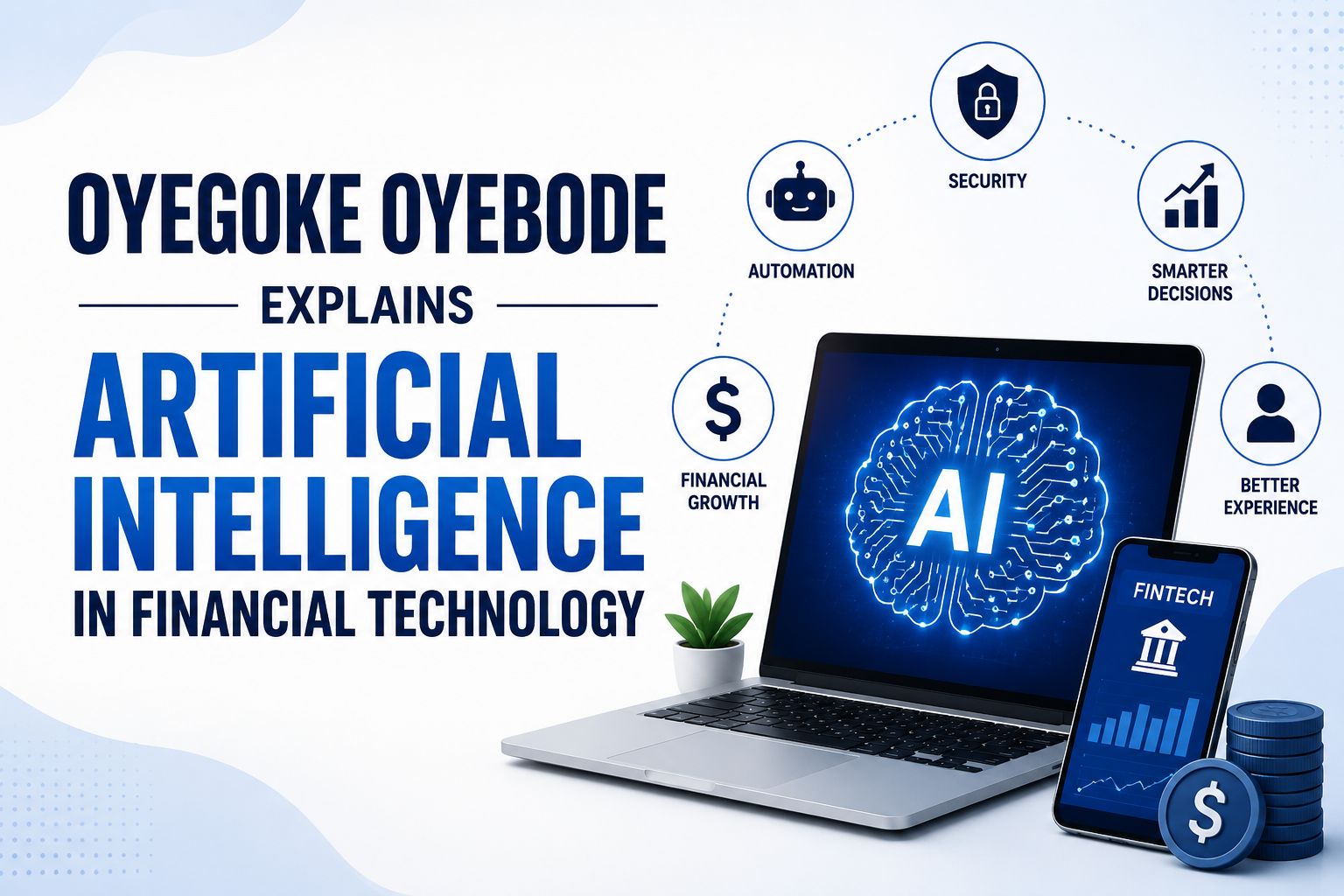
Oyegoke Oyebode Explains Artificial Intelligence in Financial Technology
Artificial Intelligence (AI) is changing the way people use financial services. From making online payments faster to detecting fraud in real time, AI has become an important part of modern financial technology (fintech). As digital banking and online transactions continue to grow, businesses need smarter and more secure solutions to meet customer expectations.
Oyegoke Oyebode, a technical program manager, engineer, and researcher specializing in fintech, artificial intelligence, and digital trust systems, believes that AI is not just a technology trend. It is a practical tool that helps financial institutions improve security, automate processes, and provide better customer experiences. Understanding how AI works in financial technology can help businesses and individuals prepare for the future of digital finance.
What Is Artificial Intelligence in Financial Technology?
Artificial Intelligence refers to computer systems that can analyze data, recognize patterns, learn from experience, and make decisions with minimal human involvement. In financial technology, AI helps banks, payment companies, insurance providers, and investment platforms work more efficiently.
Instead of relying only on manual processes, AI can quickly process millions of transactions, identify unusual activities, and provide personalized financial services. This improves both speed and accuracy while reducing operational costs.
How AI Is Transforming the Financial Industry
Financial institutions use AI in many different ways to improve their services and protect customer information.
Some of the most common applications include:
Detecting fraudulent transactions before financial losses occur.
Providing 24/7 customer support through AI-powered chatbots.
Personalizing financial products based on customer behavior.
Automating loan approvals using intelligent risk assessment.
Predicting market trends through advanced data analysis.
These applications help organizations make better decisions while improving customer satisfaction.
Benefits of Artificial Intelligence in Fintech
AI offers several advantages that make financial services more efficient and reliable.
Improved Fraud Detection
One of the biggest benefits of AI is its ability to identify suspicious activities in real time. Machine learning algorithms can recognize unusual transaction patterns that may indicate fraud. This allows financial institutions to respond quickly and reduce financial risks.
Better Customer Experience
AI-powered virtual assistants can answer customer questions instantly, helping users access banking services whenever they need support. Personalized recommendations also make financial planning easier.
Faster Decision-Making
Traditional financial processes often require manual reviews. AI analyzes large amounts of information within seconds, helping businesses make faster and more accurate lending, investment, and operational decisions.
Reduced Operational Costs
Automation reduces repetitive tasks, allowing employees to focus on more valuable work. This increases productivity while lowering operating expenses.
Challenges of Using AI in Financial Technology
Although AI provides many advantages, organizations must also address several challenges.
Data privacy remains one of the biggest concerns because financial systems handle sensitive customer information. Companies must also ensure that AI models are transparent, fair, and free from bias. In addition, regulatory compliance continues to evolve as governments introduce new rules for AI applications in finance.
Building customer trust is equally important. Organizations should explain how AI systems make decisions and protect user data to maintain confidence in digital financial services.
The Future of AI in Financial Technology
The future of fintech will be increasingly driven by AI. As technologies continue to improve, financial institutions will develop smarter systems for fraud prevention, risk management, digital identity verification, and personalized financial advice.
Emerging innovations such as generative AI, predictive analytics, and intelligent automation are expected to reshape banking, insurance, and investment services. Businesses that responsibly adopt AI while maintaining strong digital trust will be better positioned for long-term success.
Final Thoughts
Artificial Intelligence is transforming financial technology by making services faster, safer, and more customer-focused. From fraud detection to intelligent automation, AI enables financial organizations to improve efficiency while delivering better experiences.
According to Oyegoke Oyebode, the future of financial technology depends on combining innovation with security and digital trust. Organizations that embrace responsible AI practices can create more reliable financial systems while meeting the growing needs of customers in an increasingly digital world.
Frequently Asked Questions (FAQs)1. What is Artificial Intelligence in financial technology?
Artificial Intelligence in financial technology refers to the use of intelligent computer systems that automate financial tasks, analyze data, detect fraud, and improve customer experiences.
2. How does AI improve financial security?
AI continuously monitors transactions, identifies unusual patterns, and alerts financial institutions about potential fraud before significant damage occurs.
3. Why is AI important in fintech?
AI improves efficiency, reduces operational costs, enhances customer service, supports better decision-making, and strengthens fraud prevention.
4. Can AI replace financial professionals?
No. AI supports financial professionals by automating routine tasks and providing data-driven insights, but human expertise remains essential for complex decisions and regulatory oversight.
5. What is the future of AI in financial technology?
The future includes smarter fraud detection, personalized financial services, intelligent automation, predictive analytics, and stronger digital trust systems that create safer and more efficient financial ecosystems.