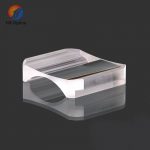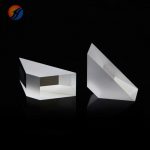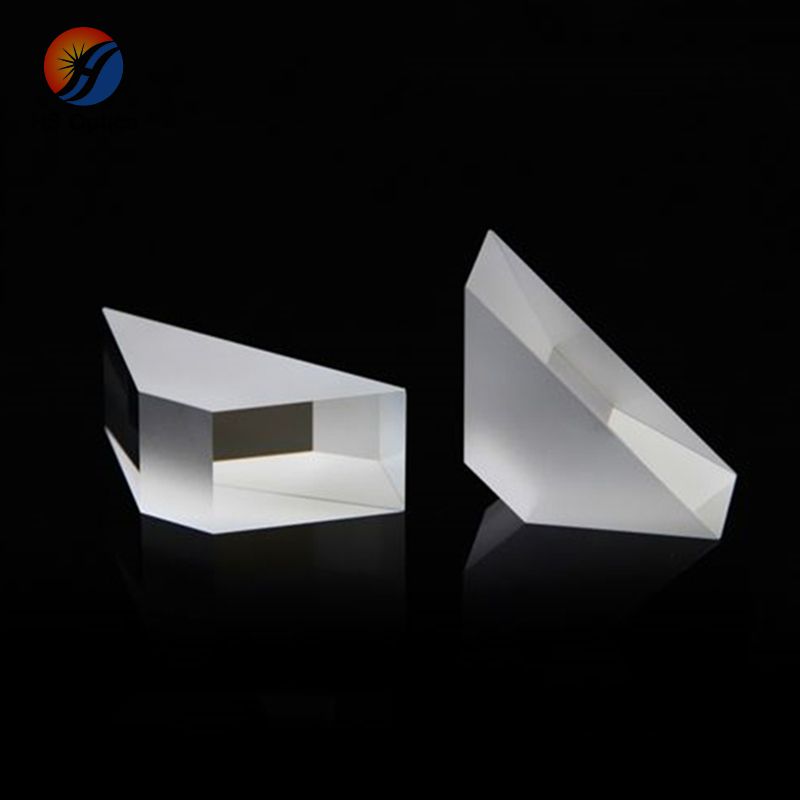
dove prism
https://www.hsgd-optics.com/optical-prism/dove-prism.html
Dove Prism
Dove prisms It resembles half of a common right-angle prism in which a ray entering parallel to hypotenuse face is reflected internally at that face and emerges parallel to its incident direction. One of the incident rays emerges along a continuation of its incident direction, and if the prism is rotated about that ray through some angle, the image rotates through twice that angle. A Dove Prism must be used in parallel light.
What Is a Dove Prism?
A Dove prism is a type of optical prism used to rotate, invert, or retroreflect an image. It has a unique shape—similar to a right-angle triangular prism with its top truncated.
These prisms are most effective when used with collimated light. Because the prism’s length is roughly four times its height, using it with converging light can introduce significant astigmatism.
When light enters through the slanted face and travels along the prism’s longitudinal axis, it reflects once off the bottom (flat) surface and exits through the opposite short side. This results in an inverted image. One of the most unique features of a Dove prism is that when the prism is rotated around its longitudinal axis, the image inside rotates at twice the speed. For example, rotating the prism by 30° will rotate the image by 60°.
Thanks to this property, Dove prisms are widely used to rotate beams of light to precise angles. While the image is flipped vertically, there is no lateral shift or angular deviation, since only a single internal reflection occurs.
Even if the light’s path is not perfectly aligned with the prism’s axis, the steep angle of incidence ensures total internal reflection (TIR) on the bottom surface. However, in applications where the hypotenuse surface may not remain clean enough for reliable TIR, metallic or dielectric coatings can be applied to maintain performance.