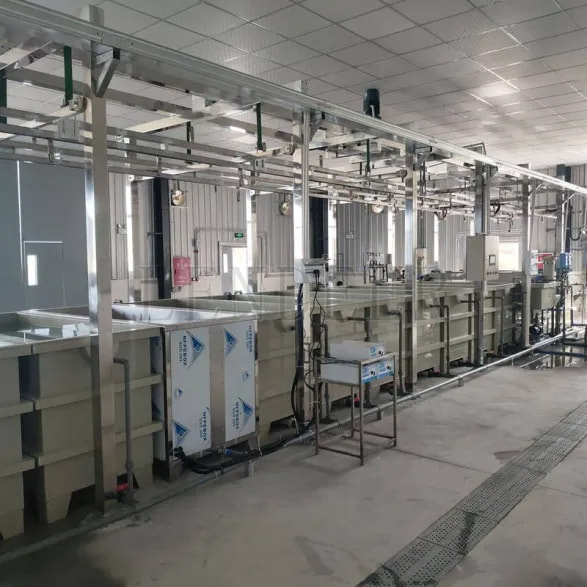
Fully Automatic Vertical Lifting
Fully Automatic Vertical Lifting Electrophoretic Coating Line
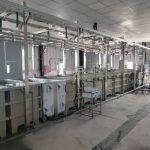
LENDEER’s fully automatic vertical lifting e-coating line combines chain-driven vertical lifting and horizontal transfer with PLC control for high-volume, single-color production of small-to-medium metal parts. Multiple racks can be processed at different stages simultaneously, improving throughput while maintaining a compact tank layout. To compare this system with other automation layouts, view our electrophoretic coating line configurations.
The line operates on a dual-motion mechanism: a vertical lift raises and lowers the work hanger into and out of each process tank, while a horizontal transfer mechanism moves the hanger along the tank row to the next station. This vertical lift + horizontal transfer cycle is driven entirely by chain transmission — a mechanically proven, low-maintenance drive system that delivers smooth, precise motion and consistent process timing across all production shifts.
PLC-based intelligent control governs the entire operation. The line supports simultaneous processing of two or more racks at different stages — while one hanger is in the e-coat tank, another is in the phosphating stage, and a third is being rinsed — maximizing equipment utilization and achieving production efficiencies that rival chain conveyor lines at a fraction of the footprint and investment cost. LENDEER supplies this line as a complete, turnkey e-coat system.
Complete E-Coating Line Process Flow
The turnkey line integrates pretreatment tanks, an e-coat tank and rectifier, UF recovery, DI water treatment, PLC controls and a curing oven. Individual units are available through our electrophoretic coating equipment range. Compatible electrophoretic paint can be selected according to the substrate, target film appearance, curing conditions and corrosion-resistance requirements.
LENDEER supplies the complete end-to-end electrophoretic coating line — from pre-treatment through to curing oven — as a fully integrated, turnkey system. Taking black epoxy electrophoretic coating for iron workpieces as an example,the standard process sequence is:
Process Stage
Details
1
Loading
Workpieces are mounted on hangers or racks and loaded onto the conveyor system. Hanger design is customized for workpiece geometry.
2
Pre-Degreasing (Spray)
High-temperature alkaline spray removes bulk oils and metalworking lubricants from the workpiece surface.
3
Main Degreasing (Spray/Immersion)
Complete removal of all surface contaminants. Critical foundation for downstream process quality.
4
Water Rinsing
Multiple rinse stages remove chemical residues. Later stages use pure (DI) water to prevent ionic contamination.
5
Surface Conditioning
Titanium colloid treatment activates the metal surface for uniform phosphate crystal nucleation.
6
Phosphating
Zinc or iron phosphate conversion coating improves e-coat adhesion and corrosion resistance by 3–5×.
7
Pure Water Final Rinse
DI water rinse (< 10 μS/cm) removes all ionic residues immediately before the e-coat tank.
8
Electrophoretic Coating
Workpieces are immersed in the e-coat bath. DC voltage drives uniform paint deposition on all surfaces.
9
UF Permeate Rinse
Post-electrophoresis rinsing with UF permeate recovers drag-out paint (>90% recovery).
10
Curing Oven
Baking at 180–190 °C for 20–30 min cross-links the e-coat film into a hard, durable, corrosion-resistant finish.
11
Unloading & Inspection
Finished workpieces are unloaded, inspected for film thickness, adhesion, and appearance, and transferred to the next process.
Process stages are customized to your workpiece material, contamination type, and coating quality requirements. LENDEER provides full process engineering documentation for each project.