Semi-automatic hoist electrophoretic coating line
Semi-automatic hoist electrophoretic coating line
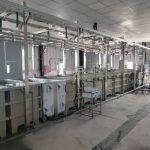
A defining engineering feature of this line is its tank geometry: all process tanks — pre-treatment, e-coat, and rinse stages — are designed as rectangular tanks with internal dimensions only marginally larger than the work hanger’s swept volume. This tight-fitting design dramatically reduces bath volume compared to continuous flow-through tanks used in automatic lines. Less bath volume means less e-coat paint inventory, less pre-treatment chemical fill, lower heating energy consumption, and lower cost of bath maintenance and disposal — all directly reducing operating cost per unit produced.
The hoist mechanism transforms the physical handling of large, heavy workpieces from a two- or three-person manual operation into a controlled, single-operator task. By enabling precise entry angle control as the hanger swings into the e-coat bath, the hoist also delivers a key quality benefit unavailable on fixed-position automatic systems: air pockets trapped in cavities, blind holes, and complex internal geometries are displaced as the workpiece enters the bath at a controlled angle, guaranteeing complete surface coverage on even the most geometrically challenging workpieces. LEDE supplies this system as a complete, turnkey E-Coat Line.
Complete E-Coating Line Process Flow
LEDE supplies the complete semi-automatic electrophoretic coating line — pre-treatment tanks, e-coat tank with rectifier, UF unit, pure water equipment, curing oven, and all auxiliary systems — as a fully integrated, turnkey package. Taking black epoxy electrophoretic coating for iron workpieces as an example, the standard process sequence is:
Process Stage
Details
1
Loading
Workpieces are mounted on hangers or racks at the loading station. Hanger geometry is customized for workpiece dimensions and e-coat coverage requirements.
2
Pre-Degreasing (Spray / Immersion)
Alkaline degreaser removes bulk oils, lubricants, drawing compounds, and metalworking fluids. Bath temperature 50–65 °C.
3
Main Degreasing
Complete surface cleaning. Critical for downstream phosphating adhesion and e-coat film quality.
4
Water Rinsing
One or more rinse stages remove degreaser residues. Final rinse uses DI water.
5
Surface Conditioning
Titanium colloid activates the metal surface for uniform, fine-grained phosphate crystal nucleation.
6
Phosphating
Zinc or iron phosphate conversion coating; 3–5× improvement in e-coat adhesion and corrosion resistance.
7
Pure Water Final Rinse
DI water rinse (
8
Electrophoretic Coating
Motor-driven or hoist-controlled immersion in e-coat bath. DC voltage applied (50–400 V). Dwell: 1–2 min. Uniform deposition on all surfaces.
9
UF Permeate Rinse
Post-electrophoresis closed-loop rinse with UF permeate recovers > 90% of drag-out paint.
10
Curing Oven
Workpieces baked at 180–190 °C for 20–30 min; e-coat film cross-links into a hard, corrosion-resistant finish.
11
Unloading & QC Inspection
Finished workpieces unloaded, inspected for film thickness, adhesion, and surface quality.
Process stages are engineered to your workpiece material, contamination profile, and coating quality specification. LEDE provides full process documentation and operator training for each project.